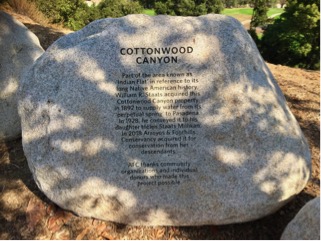
Cotton Wood Canyon Look-Out: (Park on east side of Linda Vista at the interpretive rock marker (Latitude: 34° 10’ 50.418” N, Longitude: 118° 10’ 28.668” W) This goes on map as well as in QR link
You are now standing in Cotton Wood Canyon, an 11 acre parcel set aside in 2017 as a wildlife corridor for animals moving west from the Arroyo Seco into the San Rafael Hills. The area now known as Linda Vista was once called “Indian Flats,” and was home to Native Americans, the Tongva, for centuries until displaced by settlers in the early 1900s. People were attracted to the space because it offered annual spring water that is still present today. Artifacts found in the lush riparian environment along the stream detail human activity from a time long ago. Early pioneers captured spring water in glass bottles and sold it to markets in nearby Los Angeles under the name, Cottonwood Canyon Water Company. The canyon served as the main water source for what would later be founded as the City of Pasadena. Today only a short hike from the interpretive marker, one will find pipe irrigation remnants that tapped the spring water deep inside a 10’ mine shaft. The irrigation traveled to the first citrus orchards nearby, thus officially establishing the town of Pasadena in 1875.
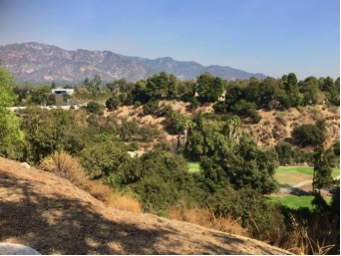
Looking northeast the stop reveals a scenic view of the San Gabriel Mountains home to a large number of unique plants and animals. Imagine the water traveling from the 4000’ peaks, through the watershed, moving southwest along the Arroyo Seco, and finally connecting to the Los Angeles River a passage to the sea. As the year round water travels so does local wildlife. The protected corridor is an uninterrupted path for mammals such as mule deer, mountain lion, bobcat, coyote, gray fox, black bear, raccoon, striped skunk, Virginia opossum, long-tailed weasel, Audubon’s cottontail rabbit, California ground squirrel, fox squirrel, western gray squirrel, Merriam’s chipmunk and a large number of various rodents. The thick tree canopy of the riparian woodland adjacent with shrubs of the chaparral serve as home to a large number of permanent and migrating birds.
As you stand in the wild space close your eyes, listen, imagine a time of the past in Cotton Wood Canyon. What do you see, what do you hear? Are there people? Animals? What are they doing?
Cottonwood Canyon Wildlife Camera:
https://youtu.be/bgHiwHfEJrs