STOP #1
Upper Arroyo / Gabrielino Trail
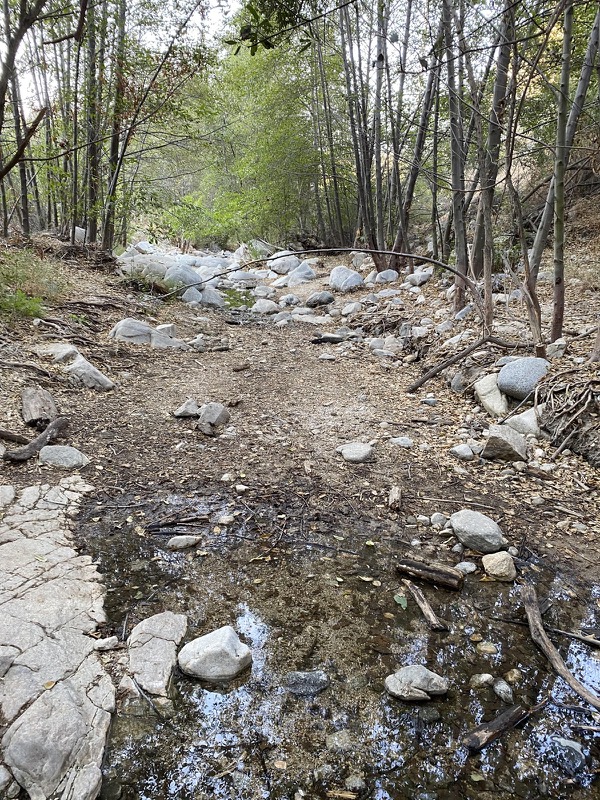
You are standing at the beginning of the Gabrielino trail. Gabrielino is the name that was given to the indigenous communities, encompassing a few different tribes living in the region at the time of Spanish settlement. Before the arrival of the Spanish and other European settlers, this particular area was populated by the Tongva people. Villages dotted the waterways emerging out of the San Gabriels and lined the major rivers all the way to the coast. The Arroyo Seco was an important region, providing everything for a thriving nation of people. The streams provided fish and fresh water, oak trees provided acorns to be ground into a meal used for breads and porridge , there were berries to be gathered, and animals to hunt. To the untrained eye, the dry hillsides may seem inhospitable and void of sustenance. But, upon a closer look, one can see that there is much more here than meets the eye.
The Gabrielino trail features three distinct California landscapes: chaparral, riparian, and oak woodland. At the outset of the trail, the hillside slopes are host to chaparral shrubs, dominated by CA Buckwheat and Laurel Sumac. Along the creek, you will notice that the chaparral plants give way to Western Sycamores, Mulefat, and Oak Trees. In the Oak Woodlands, take note of how the understory changes. Depending on the time of year you visit, you could see many colorful blooms or beautifully intricate seeds and seed pods. Be mindful that there is lots of Poison Oak in the area, distinguished by its waxy leaves, reddish in the fall, and occurring in sets of three along the stem - hence the warning phrase, “Sets of three? Leave it be.” European settlement and urban development have made their impact in the plant communities too. Non-native and invasive species such as Star Thistles, Tobacco Tree plants, Wild Mustard, and Ash Trees are just a few that have taken hold in the foothills of the San Gabriel Mountains.
As you walk along the trail, notice how the temperature changes as you move from chaparral to riparian to oak woodland areas. What might be the reason for the temperature changes? How might temperature affect the plant communities?
The Upper Arroyo Seco is home to many animals, both large and small. Squirrels, lizards, birds, snakes, deer, mountain lions, and bears are some of the active members of the San Gabriel Mountains. While it is very rare to spot the larger mammals such as mountain lions or bears, the smaller animals make themselves known more readily. Search the creek bed for newts, frogs, and tadpoles, watch for lizards sunning themselves on rocks, and listen to the different bird calls. Note: It is important to stay on the trails and places where you can clearly see where you are taking your next step, as there are rattlesnakes in the area. The Arroyo Seco was once home to many species of fish, but dams and other human activity have greatly impacted the fish in this habitat. It is believed that the only two native species live in the creek today, Rainbow Trout and the Arroyo Chub (reintroduced in 2008).
Walk along this trail as far as you like, pay attention as you weave in and out of the different plant communities, and take a quick side trip to the creek’s edge. Also take notice of the human impacts to the area. Like every natural environment, the closer to you look, the more you see.
Upper Arroyo / Gabrielino Trail
You are standing at the beginning of the Gabrielino trail. Gabrielino is the name that was given to the indigenous communities, encompassing a few different tribes living in the region at the time of Spanish settlement. Before the arrival of the Spanish and other European settlers, this particular area was populated by the Tongva people. Villages dotted the waterways emerging out of the San Gabriels and lined the major rivers all the way to the coast. The Arroyo Seco was an important region, providing everything for a thriving nation of people. The streams provided fish and fresh water, oak trees provided acorns to be ground into a meal used for breads and porridge , there were berries to be gathered, and animals to hunt. To the untrained eye, the dry hillsides may seem inhospitable and void of sustenance. But, upon a closer look, one can see that there is much more here than meets the eye.
The Gabrielino trail features three distinct California landscapes: chaparral, riparian, and oak woodland. At the outset of the trail, the hillside slopes are host to chaparral shrubs, dominated by CA Buckwheat and Laurel Sumac. Along the creek, you will notice that the chaparral plants give way to Western Sycamores, Mulefat, and Oak Trees. In the Oak Woodlands, take note of how the understory changes. Depending on the time of year you visit, you could see many colorful blooms or beautifully intricate seeds and seed pods. Be mindful that there is lots of Poison Oak in the area, distinguished by its waxy leaves, reddish in the fall, and occurring in sets of three along the stem - hence the warning phrase, “Sets of three? Leave it be.” European settlement and urban development have made their impact in the plant communities too. Non-native and invasive species such as Star Thistles, Tobacco Tree plants, Wild Mustard, and Ash Trees are just a few that have taken hold in the foothills of the San Gabriel Mountains.
As you walk along the trail, notice how the temperature changes as you move from chaparral to riparian to oak woodland areas. What might be the reason for the temperature changes? How might temperature affect the plant communities?
The Upper Arroyo Seco is home to many animals, both large and small. Squirrels, lizards, birds, snakes, deer, mountain lions, and bears are some of the active members of the San Gabriel Mountains. While it is very rare to spot the larger mammals such as mountain lions or bears, the smaller animals make themselves known more readily. Search the creek bed for newts, frogs, and tadpoles, watch for lizards sunning themselves on rocks, and listen to the different bird calls. Note: It is important to stay on the trails and places where you can clearly see where you are taking your next step, as there are rattlesnakes in the area. The Arroyo Seco was once home to many species of fish, but dams and other human activity have greatly impacted the fish in this habitat. It is believed that the only two native species live in the creek today, Rainbow Trout and the Arroyo Chub (reintroduced in 2008).
Walk along this trail as far as you like, pay attention as you weave in and out of the different plant communities, and take a quick side trip to the creek’s edge. Also take notice of the human impacts to the area. Like every natural environment, the closer to you look, the more you see.